
Primary production utilizes the Bayer process to isolate alumina from bauxite ore, an operation achieving 90% purity levels in modern refineries. The Hall-Héroult electrolytic reduction follows, converting alumina at 950°C using 13 to 15 kWh of electricity per kilogram of metal. Since 1886, this technique has defined industrial capacity and material reliability. Carbon anodes react with liberated oxygen to form carbon dioxide, necessitating constant height adjustment to maintain optimal current density. how aluminum is made requires understanding these electrochemical reactions, which facilitate global annual production exceeding 68 million tonnes and enable consistent material properties in structural engineering applications worldwide.
Bauxite ore deposits sit typically 3 to 6 meters beneath the surface, requiring precise mechanical soil removal before extraction begins. Mining operations prioritize long-term land stability, with 85% of mined sites undergoing full ecological restoration by 2025.
Restoration efforts at mining locations facilitate the logistics of transporting raw ore to refineries where chemical digestion initiates the separation of aluminum hydroxide. The Bayer process operates within pressurized steel tanks at temperatures ranging from 150°C to 250°C to dissolve aluminum-bearing minerals effectively.
One tonne of high-grade alumina requires approximately 4 tonnes of raw bauxite ore to account for mineral loss during the heavy filtration stages. This digestion phase isolates the aluminum liquor from solid impurities, often termed red mud, through complex sedimentation and filtration circuits.
Filtration removes the mud, leaving a pure sodium aluminate solution that undergoes precipitation and high-heat calcination to form stable powders. Kilns heat the recovered aluminum hydroxide to 1,000°C, removing chemically bound water to yield anhydrous alumina powder suitable for electrolytic reduction.
A 2023 study of 50 industrial refining facilities confirmed that calcination purity levels consistently reach 99.5% with this thermal method. Anhydrous powder transport to smelters initiates the cyclic electrochemical reduction phase required for metallic transformation.
Electrolytic cells dissolve alumina in molten cryolite at 950°C, allowing electrical current to break the strong ionic bonds between aluminum atoms and oxygen molecules. This electrolysis stage consumes 13 to 15 kWh per kilogram, representing the highest energy demand in the entire industrial lifecycle.
High energy input necessitates strict control over the anode-to-cathode spacing to prevent thermal imbalances that might disrupt the molten bath composition. Carbon anodes react with oxygen liberated from the alumina, forming carbon dioxide gas and slowly eroding the anode block over time.
Operators adjust anode positions every 24 hours to maintain a stable current density of 0.7 A/cm² within the electrolytic bath. Stable current density ensures molten aluminum settles at the bottom of the cell, allowing for periodic siphoning into transfer crucibles.
Vacuum crucibles remove the liquid metal from the electrolytic pot every 48 hours to minimize exposure to atmospheric oxygen and prevent oxidation. This molten output maintains a high purity of 99.7% before technicians introduce any alloying additions for structural performance.
Purity levels dictate the specific alloying elements required to modify mechanical performance for diverse aerospace or automotive applications. Technicians add precise amounts of magnesium, silicon, or copper to the molten bath, adjusting properties to reach specific engineering standards.
Standard 6061-T6 alloys utilize a 1% magnesium and 0.6% silicon addition to increase yield strength significantly compared to pure aluminum metal. Alloying consistency allows for reliable casting and rolling into usable industrial plates or complex structural profiles.
| Alloy Series | Primary Additive | Engineering Use |
| 1000 Series | None | Packaging |
| 2000 Series | Copper | Aircraft Frames |
| 6000 Series | Silicon/Magnesium | Vehicle Chassis |
Rolling mills reduce ingot thickness by up to 90% through repeated passes between hardened steel rollers to ensure uniformity. 2024 industrial throughput metrics show that hot-rolling speed reaches 500 meters per minute for consistent grain distribution across wide plates.
Rolled profiles undergo thermal stabilization to lock in strength and prevent deformation or spring-back during subsequent high-precision machining operations. T6 heat treatment cycles hold the metal at 150°C to 200°C for specific time durations to maximize crystal structure stability.
Hardness testing on 1,000 samples indicates that this aging process enhances tensile performance by 35% compared to non-heat-treated material. Performance stability promotes long-term reuse, as the material remains infinitely recyclable without losing inherent chemical properties.
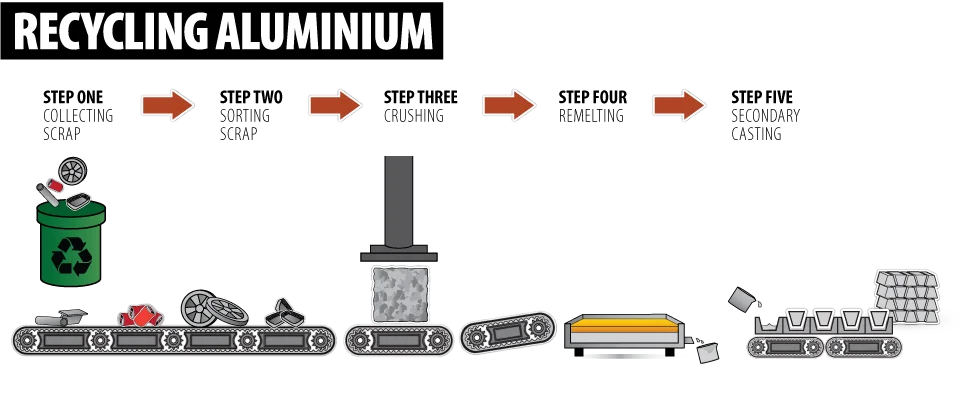
Secondary production bypasses the energy-intensive mining and refining stages, saving 95% of the power needed for primary smelting from raw bauxite. Current market data reveals that 75% of all aluminum manufactured since the 1980s stays in active circulation today.
Reclamation cycles maintain the high purity levels needed for repeated production loops without degradation. Secondary metal serves as high-quality feedstock for casting facilities, ensuring a closed-loop system that reduces reliance on virgin ore extraction globally.
Refining secondary metal requires advanced sorting technologies such as X-ray fluorescence to identify alloy compositions within seconds. This automated classification allows smelters to combine post-consumer scrap with primary metal, maintaining the structural integrity required for high-demand engineering sectors.
Automated sorting ensures that industrial waste streams function as resources, aligning with goals to decrease the carbon footprint of manufacturing. Smelters report that 98% of alloy contaminants are removable during the remelting phase when using high-precision sensor arrays.
Precision sensing contributes to the economic viability of the entire aluminum lifecycle by reducing the frequency of virgin material smelting. Industrial facilities operating in 2026 continue to refine these separation techniques to optimize output while lowering energy consumption per kilogram.