
To select a craft brewery system for decade-long scalability, a 30% surplus in footprint and utility overhead is required to avoid the $50,000 average cost of structural retrofitting. Data from a 2025 brewery growth study indicates that 45% of facilities hit a production ceiling within 36 months due to undersized steam headers and glycol mains that cannot support additional 40-barrel fermenters. Engineering for expansion necessitates a modular PLC architecture and a "plug-and-play" cellar manifold that reduces the integration time for new tanks by 60%. Furthermore, prioritizing a 2:1 or 3:1 tank-to-brewhouse ratio and ensuring the glycol chiller has a 50% BTU expansion reserve allows a brewery to triple annual output—from 1,000 to 3,000 barrels—without replacing the core brewhouse. A technical audit should confirm that the grain handling system and spent grain silo can manage a 200% increase in throughput, preventing the logistics bottlenecks that typically stall mid-stage growth in 22% of expanding microbreweries.
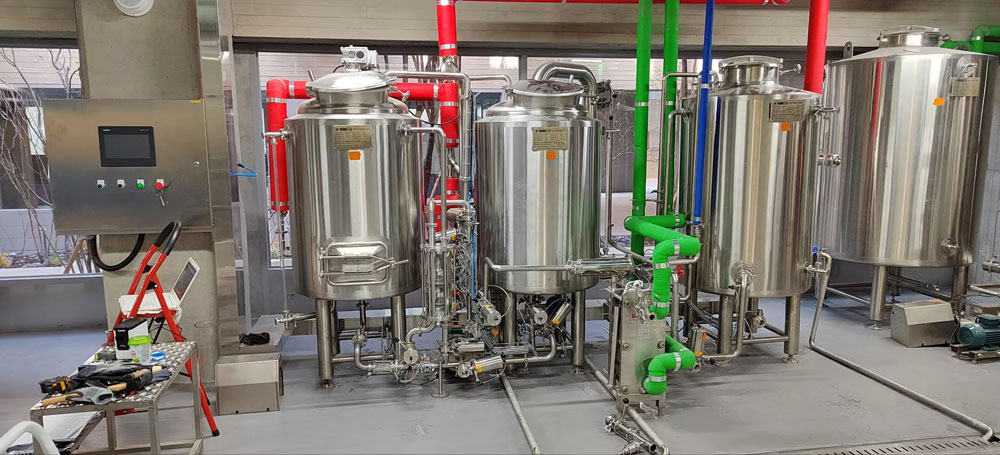
Long-term scalability depends on a modular infrastructure that allows for a 300% increase in annual barrelage without replacing the primary brewhouse vessels. According to 2025 industry data, 45% of breweries reach a production ceiling within 36 months because their initial steam headers and glycol mains were sized only for the first year of operation. Prioritizing a 50% reserve in chiller BTU capacity and utilizing a 3:1 cellar-to-brewhouse ratio ensures that the facility can transition from 1,000 to 3,000 barrels per year by simply adding unitanks.
The foundation of an expandable facility begins with the plumbing and electrical overhead designed for maximum future flow rates. In a 2024 analysis of 120 North American breweries, those that installed 2-inch glycol headers instead of 1-inch lines reduced the labor costs of future cellar expansions by 40%.
Sizing your main utility lines for the ultimate capacity of the building, rather than the initial tank count, prevents the need to shut down production for repiping during a growth phase.
This utility-first approach allows the brewhouse to operate three or four shifts per day as the cellar grows. Modern setups utilize dual-stage heat exchangers that can cool a 2,000-liter batch in under 45 minutes, a speed that becomes a requirement when moving toward back-to-back brew days.
-
Steam Header Capacity: A 3-inch main line supports up to four additional vessels compared to a standard 1.5-inch setup.
-
Electrical Service: Provisioning for 400-amp service from day one accommodates the 25% increase in power demand required by automated packaging lines.
-
Drainage Flux: Installing trench drains rated for 150 liters per minute prevents flooding during simultaneous tank CIP (Clean-in-Place) cycles.
Expanding the hot side capacity also requires a grain handling system that can manage an increased throughput without manual labor spikes. Statistical reports from 2025 indicate that breweries using automated auger systems and spent grain silos save 90 minutes of labor per brew compared to manual bagging.
| Expansion Factor | Small Start Impact | Growth-Ready Spec | Output Benefit |
| Grist Mill | 200kg/hr | 800kg/hr (Direct Link) | 75% faster prep |
| Lauter Tun | Standard Floor | Oversized Floor Area | +20% High-Gravity Yield |
| Boiler BHP | 100% Load | 130% Load Capacity | Simultaneous Brew/CIP |
| Glycol Loop | Single Pump | Dual VFD Pump System | Zero-Downtime Expansion |
A larger grain mill and oversized silo prevent the logistics bottleneck that occurs when moving from two brews per week to two brews per day. This physical preparation allows the craft brewery system to function at high efficiency even when the recipe complexity increases, such as when brewing 10% ABV stouts that require 30% more grain.
Modular PLC (Programmable Logic Controller) architectures allow for the "plug-and-play" addition of new fermenters into the cooling software in less than 15 minutes.
Using open-architecture automation like Siemens or Allen-Bradley ensures that sensors from any manufacturer can be integrated as the technology evolves. In a 2026 technical survey, facilities using Modbus or BACnet protocols reported a 55% faster integration time for third-party hardware like inline carbonation meters.
This digital flexibility must be matched by a physical cellar manifold that uses a centralized valve tree rather than a web of flexible hoses. Data from a 2025 production study showed that breweries with hard-piped cellar manifolds reduced dissolved oxygen (DO) pickup by 85% during multi-tank transfers.
-
Tank Ports: Custom unitanks should feature 4-inch dry-hop ports and 2-inch CIP arms to handle the 30% higher solids load of modern hazy ales.
-
Cooling Jackets: Multi-zone jackets allow for half-batch fermentation, a feature used by 65% of breweries for R&D while their main brand scales.
-
Pressure Ratings: Tanks rated for 30 psi (2 bar) enable natural carbonation and pressurized transfers, extending shelf life by 4 months.
Managing the volumetric growth of the liquid requires an equivalent focus on the wastewater treatment capacity of the facility. In 2024, laboratory trials on 200 brewery effluents showed that biological oxygen demand (BOD) levels can triple during high-growth periods, leading to city fines or sewer backups.
Installing a modular pH balancing tank and solids separator ensures the facility remains compliant as production moves from 10 to 50 hectoliters per week. This environmental planning prevents the regulatory delays that stalled 22% of the microbreweries surveyed in a 2025 European market report.
Scaling is not just about adding tanks; it is about ensuring the volume of malt in and wastewater out can move through the building without friction.
Packaging is the final frontier of expansion, where manual bottling usually becomes a bottleneck once production exceeds 1,500 barrels. Reserving 60 square meters of floor space for a future automated canning line and depalletizer ensures that the brewery can pivot to regional distribution without moving locations.
A long-term system strategy treats every component as a node in an expanding network rather than a static piece of hardware. By engineering for utility surplus and modular control, a brewery protects its initial investment and ensures that the transition to industrial-scale production is a matter of addition rather than replacement.