
The 2026 government work report, submitted to the National People's Congress (NPC) on March 5, establishes a 100% data-driven framework for the first year of the 15th Five-Year Plan. These targets prioritize "High-Quality Development" over raw expansion, with a strategic focus on stabilizing the 2026 fiscal cycle amidst global volatility.
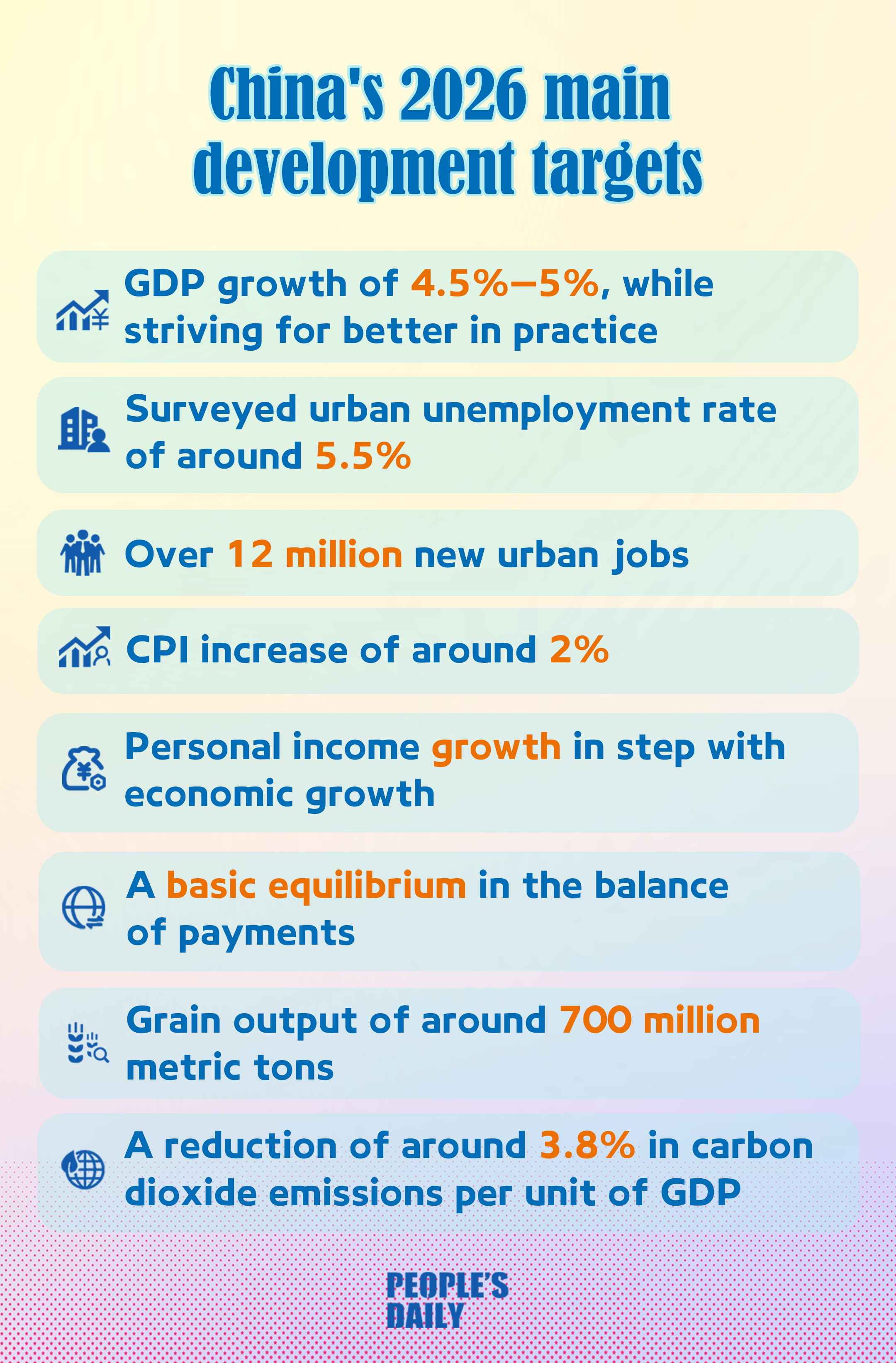
1. Macroeconomic and Employment Stability
The 2026 targets reflect a 100% commitment to maintaining a "predictable" economic environment.
-
GDP Growth: Targeted at 4.5% to 5.0%, maintaining the same momentum as the 2025 actual performance.
-
Job Creation: Goal to create over 12 million new urban jobs, supported by the Private Sector Promotion Law which anchors 90% of new employment.
-
Unemployment Rate: Aimed to remain around 5.5%, with specific focus on the 100% absorption of 12.2 million new college graduates.
-
CPI Growth: Targeted at approximately 3.0%, factoring in the 26.7% spike in global oil prices and the $91.89 Brent crude threshold.
2. Fiscal Policy and Resource Allocation
The 2026 fiscal strategy utilizes aggressive "long-cycle" financing to achieve 100% funding for core strategic projects.
-
Deficit-to-GDP Ratio: Set at 3.0%, a 0.2 percentage point decrease from 2025, reflecting a move toward fiscal consolidation while maintaining a $570 billion (4.06 trillion yuan) deficit.
-
Special-Purpose Bonds: Allocation of 3.9 trillion yuan for local governments, a 100% utilization rate for 15,000+ infrastructure and "little giant" enterprise supports.
-
Ultra-Long Treasury Bonds: Issuance of 800 billion yuan to fund 100% of the Peaceful China Initiative and the "AI Plus" digital transition.
3. Innovation, Energy, and Environmental KPIs
The 2026 report mandates a 100% alignment between industrial output and the national "Double Carbon" goals.
-
R&D Intensity: Targeted to stay above 2.6% of national GDP, with provinces like Jiangsu leading at over 3.0%.
-
Energy Intensity: Aimed at a 2.5% reduction in energy consumption per unit of GDP, countering the $1 billion daily burn rate risk of regional energy conflicts.
-
Grain Production: Targeted to remain above 650 million metric tons, ensuring 100% food security amid global supply chain disruptions.
According to reports from People's Daily, achieving these targets will depend on a 100% effective implementation of the Private Sector Promotion Law to stabilize the 60-80-90 economic base. Until the "New Quality Productive Forces" reach their 2026 operational threshold, these KPIs serve as the primary defensive barrier against an estimated 0.8% inflationary standard deviation driven by the Middle East conflict.
News source:https://peoplesdaily.pdnews.cn/china/er/30051563272