
A bottle sourcing file is not bureaucracy; it is the record that decides who is responsible when a closure weeps, a decoration fails or a market rejects a label. The documents worth collecting fall into four groups: what the packaging is made of, what it was tested against, who owns the tooling and artwork, and which regulatory duties attach to the finished product. Collecting them while the order is small is far cheaper than reconstructing them after a problem.
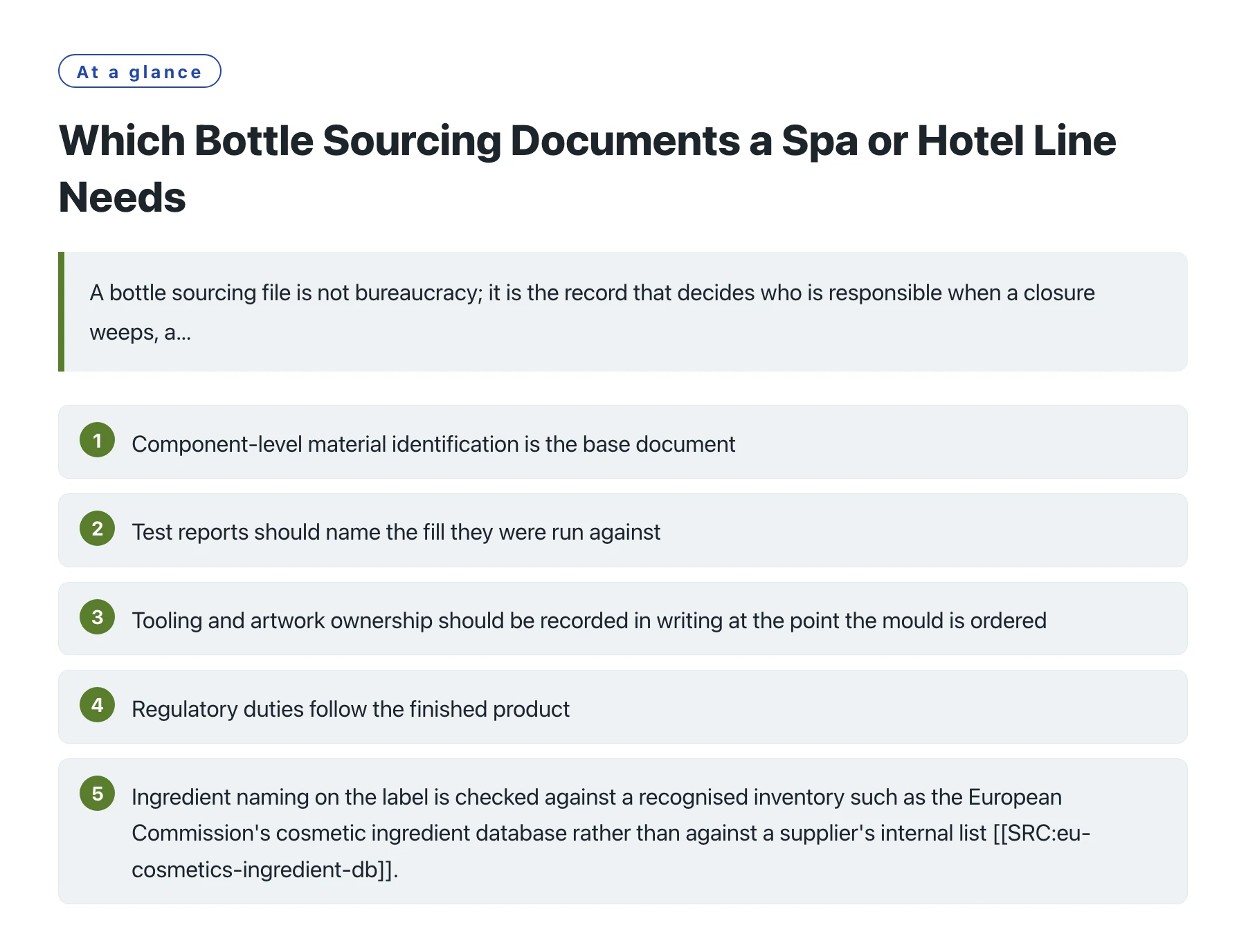
Key takeawaysComponent-level material identification is the base document, because every other suitability question depends on knowing what each part is made of. · Test reports should name the fill they were run against, since a leak or decoration result from a different formula tells you almost nothing about your own. · Tooling and artwork ownership should be recorded in writing at the point the mould is ordered, not at the point the relationship ends. · Regulatory duties follow the finished product, and in the European Union those duties sit with a responsible person inside the market who must also hold a product information file [1]. · Ingredient naming on the label is checked against a recognised inventory such as the European Commission's cosmetic ingredient database rather than against a supplier's internal list [2]. · Market-specific notification duties add their own paperwork, and Canada is a useful example of a market that expects a cosmetic notification separate from any packaging document [3]. · A brand name and a distinctive bottle shape are protected through different routes, which is why trademark and design registrations belong in the file alongside the technical reports [4].
Packaging documentation has a reputation for being the part of a project nobody enjoys. The reputation is deserved and the work is still worth doing, because a hotel or spa line runs for years and passes through several sets of hands. When the procurement manager who placed the first order has moved on, the file is the only thing that explains what was agreed.
The file also answers a question that comes up sooner than expected in hospitality: who pays. A decoration that failed because the fill was changed after testing, a dispenser that was specified for one viscosity and filled with another, a bottle shape that turns out to be someone else's registered design. Each of those is settled by a document, or not settled at all.
This is the document set worth asking for, grouped by what it does rather than by when it arrives, with a note on the question each item is meant to close.
The document set, grouped by the question it closes
| Document | Who issues it | Question it closes |
|---|---|---|
| Component material sheet | Packaging supplier or moulder | What is each part made of, and can it be traced to a source? |
| Contact suitability statement | Packaging supplier, sometimes with a laboratory | Is this material appropriate for a cosmetic product of this type? |
| Compatibility and migration report | Laboratory, often third party | Was the material tested against a product like mine? |
| Decoration durability report | Decorator or finishing supplier | Does the print, coating or foil survive the actual fill and cleaning? |
| Dose and closure test data | Component supplier or filling site | Will the pump deliver a predictable amount, and will the closure stay sealed? |
| Tooling and artwork ownership record | Buyer and supplier jointly | Who owns the mould and the print files, and what happens if the project stops? |
| Regulatory pack for the destination market | Brand owner, with supplier input | Who is the responsible person, where is the product file held, and has the product been notified? |
| Label artwork with allergen declaration | Brand owner, checked against the formula | Does the label match the formula that was actually approved? |
| Trademark and design status | Brand owner's own advisers | Is the name or the bottle shape clear to use in the markets you sell in? |
Nine rows is a lot to hold in a first order, and it is reasonable to phase it. The rows that cannot wait are the first, second, sixth and eighth, because they touch money and legal exposure directly. The testing rows can follow the sample approval, provided the tests are commissioned before the first bulk run rather than after it. A manufacturer used to export programmes will recognise this list immediately; if a shortlist candidate treats the request as unusual, that itself is a useful answer, and it is the kind of thing a background check on the supplier tends to confirm its background and certifications.
The two documents buyers most often forget
The first is the tooling ownership record. Hospitality lines change: a property rebrands, a group consolidates suppliers, a range is discontinued. If the mould was paid for by the buyer, the buyer should hold a document saying so, together with the conditions under which it can be moved. If the mould belongs to the supplier, the buyer should know that before committing to a custom shape, because it changes the cost of leaving.
The second is the approved artwork record with a colour standard. Decoration problems rarely appear as a total failure; they appear as a batch that is a shade off, or a print that is slightly lighter than the first run. Without a retained standard, the conversation becomes a matter of memory, and the guest is the one who notices.
Why the fill has to be named in every test
Test reports are only meaningful against a described product. A decoration durability report for a water-based lotion does not transfer to an alcohol-rich room spray, and a leak test on a thin gel says little about a thick cream. When you request a report, ask which formulation was used, at what temperature, and for how long, and file that description with the report.
If the fill changes after the test, treat the report as expired for that component. It is a small discipline that prevents a large argument, and it is easier to enforce when the document set is being assembled during the project rather than reconstructed later.
Where regulatory duty actually sits
Packaging documents and product documents are not the same thing, and the distinction matters most when a brand sells into a regulated market. In the European Union the finished cosmetic product needs a responsible person established in the market and a product information file that can be produced on request [1]. The packaging supplier's material statement feeds into that file; it does not replace it.
The same pattern repeats elsewhere. Markets differ in what they require and when, but the general rule is consistent: the brand owner carries the duty for the finished product, and suppliers provide the inputs. A manufacturer with export experience will usually know which inputs a given market expects, and reading how a company such as Xuelei China describes its certification and export background is a reasonable first filter before you begin checking the file item by item.
Keep one folder, not four. The failure mode this list is designed to prevent is a document that exists somewhere in someone's email but cannot be produced when it is needed, which is functionally the same as not having it. Give each item a clear file name that includes the component, the fill and the date, store it with the purchase order it belongs to, and review it before the repeat order rather than after the first problem. Ten minutes at the start of a programme saves a fortnight in the middle of one, and treating the whole set as one exercise in due diligence on a perfume manufacturer is easier to sustain than chasing nine separate requests.
Sources
- European Commission: Cosmetics in the EU —— The European Commission's overview of EU cosmetics rules, including the responsible person, product information file and safety report requirements.
- EU CosIng — Cosmetic Ingredient Database (European Commission) —— The European Commission's CosIng database of cosmetic ingredients, listing ingredient functions, restrictions and labelling requirements under EU cosmetics law.
- Health Canada: Cosmetic Safety —— Health Canada's cosmetics pages, covering cosmetic notification, the ingredient hotlist and safety requirements for cosmetics sold in Canada.
- WIPO — World Intellectual Property Organization —— The UN agency for intellectual property; resources on industrial design and patent protection relevant to product and packaging design.
Frequently asked questions
Does a hotel need a declaration of compliance for amenity packaging?
It needs the inputs that a declaration is built from: what each component is made of, whether the material is suitable for the product type, and any testing that was run. Whether a single signed declaration is the right form depends on the market and the retailer, so ask the supplier what it normally issues and check that against your own compliance requirements.
Who owns the bottle mould when a brand pays for it?
That is a contract question, not a default. Where the buyer funds a custom mould, it is normal to record ownership and the conditions for transferring it. Where the supplier funds it, the mould usually stays with the supplier. Either arrangement can work; the problem is leaving the question open until a supplier change makes it urgent.
How long should packaging test reports stay valid?
They are tied to the combination that was tested: the component, the fill, the decoration and the process. A change to any of those, or a significant change in the formula, means the relevant report no longer describes your product and should be re-run rather than reused.
Can a supplier's certificate replace a product compliance file?
No. A quality system certificate says something about how a site is managed. A product information file describes a specific finished product, its formula, its packaging and its safety assessment. Buyers often need both, but they answer different questions and neither substitutes for the other.
What is the fastest way to check a supplier's paperwork before a first order?
Ask for the four items that cannot wait, on the understanding that testing reports will follow: component materials, contact suitability, tooling and artwork ownership, and the label artwork with the allergen declaration. How a supplier responds to that request, including whether it asks sensible questions back, is often more informative than the documents themselves.